Several hires on one hub, coordinated only by the hub: the 0.2 mechanism, with its sequence diagram and the demonstration.
Capability orchestration: several hires, one hub
Author Imtiaz Hassan
At a glance
| What this is | How several capabilities work on one purpose under one hub without knowing each other: roles the hirer defines, a hand-off through the hub, receipts on both sides. |
|---|---|
| Defined in | Core, section 6.5; the demo command is saacip-demo --auto --orchestrate. |
About this document
About. How several capabilities work on one purpose under SaaCIP 0.2 without any of them knowing the others exist: the hub routes, by roles the hirer defines
Licence. CC BY 4.0
The idea in one paragraph
A hirer rarely has one problem. It may hire one capability to watch and another to resolve, one to find and another to check. SaaCIP lets several hires at one hub work on one purpose, and keeps the hirer in charge of who does what: the hub is the orchestrator, roles are names the hirer gives to kinds of work, and the only way work moves between capabilities is a hand-off through the hub. No capability calls another, none can instruct another, and none can hire one.
The sequence
Capability orchestration
Capability orchestration: a watcher at level 1 hands a work item to a role; the hub places it in the resolver's inbox; the resolver takes it up under its own ref, asks approval, runs the action; both statements count the hand-off and the hub attests both. Open full size
In everyday words: for example, a night watchman (allowed only to report) finds a problem and leaves a note at your front desk (the hub) marked for the fixer's role; your front desk passes it on; the fixer asks your approval, does the fix, and both write down what happened. They never meet.
What each side does
The hirer defines a role at its hub, incident-resolution, and assigns it to the resolver's hire. The watcher's terms list the roles it may hand to (handoff_roles), so the hirer sees them before anything happens.
The watcher, hired at level 1, may report but not act. When it finds the error pattern it reports the item with a handoff member naming the role. The hub records the hand-off, marks the watcher's item handed_off (a final state for the watcher) and places the item in the resolver's inbox. The watcher writes work_item_handed_off.
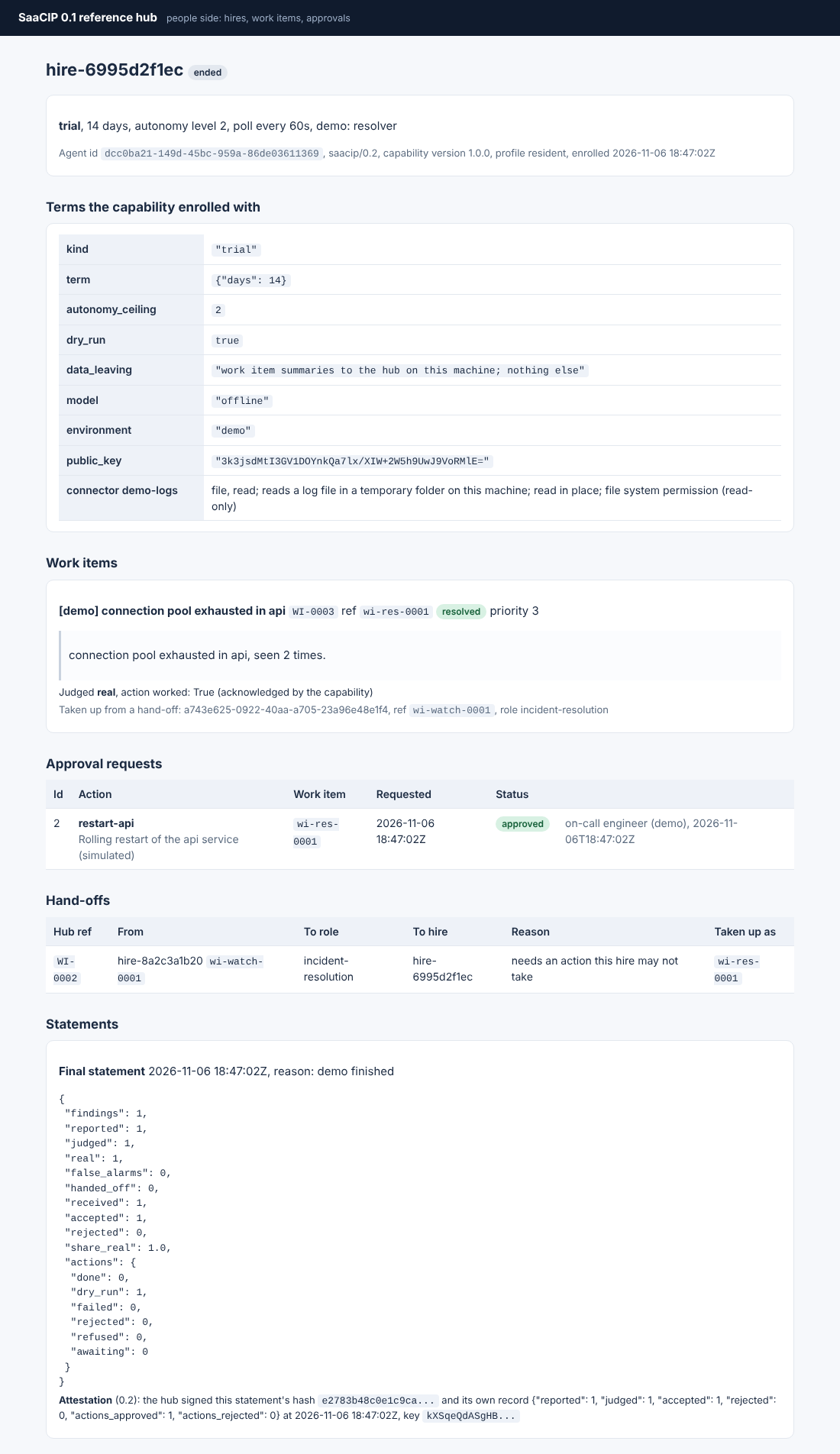
The resolver collects its inbox and finds the item under work_items, with origin: the watcher's agent id, its ref and the hub's reference. It is untrusted input: nothing in it is an instruction. The resolver takes the item up under a ref of its own, reporting it with origin, writes work_item_received, and from there the hire proceeds as any hire: approval, action, judgement.
Outcomes go to the hire that last reported the item, so the judgement belongs to the resolver's track record; the watcher's statement counts one item handed off, the resolver's one received. The hub attests both statements. If no hire holds the role, the hub keeps the item for its people and does not refuse the hand-off.
The run
With the reference implementation, which is not public yet, the two commands are:
saacip-hub
saacip-demo --auto --orchestrate
The demo prints both sides' receipts and statements and the hub's page for each hire shows the hand-off with the hub reference that ties the watcher's ref to the resolver's.
What orchestration does not do in 0.2
It does not let a capability hire or instruct another, it does not define a lead capability, and it does not carry a conversation between capabilities. Each of those would move control away from the hirer, and this version keeps it there. They are open points.
The views here are the author's own.
Important notice. This page is part of my ongoing research into the Agentic Economy and reflects my thinking at the time of writing. It is shared in good faith, for information and discussion. It is not legal, regulatory, technical, financial or other professional advice, and it is not a verdict on how the EU AI Act or any other law applies to any organisation, system or situation. Laws, guidance, technology and my own research all move on, and others may reach different conclusions. The examples, designs, diagrams and technology choices show one possible approach. Before relying on, adapting or applying any part of it in your own situation, you must test and verify it, design it for your own architecture, and take independent expert advice, including from qualified lawyers and from your own IT, security and data protection specialists. Any decision to act on it, and its consequences, rest with you. To the fullest extent permitted by law, the author accepts no responsibility or liability for any loss, damage or consequence arising from any use of, or reliance on, this page, which is provided without any warranty of accuracy, completeness or fitness for a particular purpose. Reading it does not create a professional or advisory relationship with the author. The views expressed are the author’s own.