From SaaS to SaaC: Why the Delivery Model Has to Change
SaaS was the right answer for twenty years. The question has changed: the caller is no longer human, and the unit of sale is no longer the seat.
AI agents do not sit in seats. Sell what your software can do, and charge each time it does it.
- Your next customer may be software. AI agents, not people, increasingly call your product, and they never see your user interface.
- Seats stop making sense. An agent may call a service fifty times a minute at 3 a.m.; per-user pricing gets the bill wrong in both directions.
- Sell capabilities, not applications. SaaC (Software as a Capability) packages one job with a machine-readable description, priced per use.
- Documentation becomes the shop window. Agents decide whether to use you by reading that description, so a PDF of API docs is no longer enough.
Bottom line. A usage meter bolted onto SaaS is not enough; agents choose the products they can read, call and trust.
Below: the full article, for technical teams ↓ Watch the episodeSaaS to SaaC Model | AIM Pattern | The AI Era ShiftThe Software Lens on YouTube →
"SaaS was the right answer for twenty years. The question has changed."
What SaaS solved
To understand why SaaS is not the right delivery model for the next decade, we have to be fair about what it solved for the last two.
SaaS, Software as a Service, replaced on-premise installation with a multi-tenant hosted model. It solved, in one stroke, three enormous problems: distribution (anyone with a browser and a credit card could adopt), operations (the vendor ran the infrastructure, not the customer), and iteration speed (new features deployed centrally, not by an IT department upgrading a binary). The business model that rode these three solutions (per-seat pricing, annual contracts, net-retention metrics) produced the some of the most successful software companies of their era. Salesforce, Atlassian, ServiceNow, Workday: SaaS was not just a delivery model; it was a business model that matched its delivery.
It is worth pausing on that last sentence, because the pattern-literate reader will recognize it as the decisive observation. Delivery models that match their business models compound; delivery models that fight their business models stall. SaaS compounded because the unit of sale (a seat) and the unit of delivery (a browser session) were the same thing, photographed from two angles. Finance paid for seats; a user occupied a seat; the vendor measured seat usage; renewal negotiations turned on seat expansion. This tight loop (one unit, three stakeholders, zero translation loss) is what made the SaaS business model legible to finance, to engineering, and to customers simultaneously. Previous generations of software had no such unity: a shrink-wrapped licence, a perpetual-with-maintenance contract, and a user install were three different things that accountants reconciled by hand.
SaaS assumed, correctly for its era, that the caller was a human being at a browser, or code a human had written in advance. Every product decision flowed from this assumption. For most vendors the user interface (UI) was the product; where there was an application programming interface (API), it was an integration surface that a developer read once, wired up and left running. Documentation was for those developers, not for discovery at run time. Pricing was mostly per seat because humans sat in seats, and even the API-first vendors that priced per call expected a developer to decide in advance which calls would be made. Success metrics (daily active users, feature adoption, session length) measured human consumption. What is new is not a machine caller. It is a caller that decides for itself, at run time, what to call.
The assumption was so deeply embedded that most product teams never had to surface it. Onboarding flows assumed a human who could read. Notification cadences assumed a human who would be annoyed by too many pings. Rate limits were generous because a human could not realistically issue more than a few calls per second. Error messages were written in English prose because the recipient was a person. The entire vocabulary of "user experience" (friction, delight, flow, engagement) presupposed a biological nervous system at the other end of the wire. None of this was wrong. It was simply fitted to its caller, the way a saddle is fitted to a horse.
What breaks when the caller is an agent
When the primary caller becomes an agent (composed, stateful, negotiating multiple tools at runtime) every SaaS assumption breaks or bends uncomfortably.
The UI is no longer the product. The agent does not use the UI. The API becomes the product, and the API has to be shaped for reasoning callers (MCP, the Model Context Protocol that agents use to find and call tools, and the capability manifest described in The Anatomy of a Capability).
Per-seat pricing is wrong. An agent may call a capability fifty times in a minute at 3 a.m. on a Saturday; it does not sit in a seat. Seat-based billing mis-prices usage in both directions: over-charging low-agent-use customers, under-charging high-agent-use ones.
Success metrics change. Daily active users stop telling you much; capability invocations per business outcome do. Session length stops mattering; cost-to-resolution does.
Documentation becomes executable. API documentation written as a PDF for human readers is not enough. An agent needs a machine-readable description, such as an MCP tool definition, that says clearly what the tool does and shows worked examples.
Integration becomes continuous. The model was: integrate once, operate for three years. The new model: agents discover capabilities continuously, compose them at runtime, and can start using a new capability soon after it is published.
Failure modes change shape. A SaaS outage is binary and loud: the login page errors, tickets spike, the vendor posts an incident. An agentic capability fails in subtler registers: a model's confidence collapses, an output schema drifts, a guardrail silently rejects a call. The operational discipline of SaaS (uptime dashboards, credits under a service-level agreement or SLA, quarterly business reviews) maps poorly onto these subtler failures. New instrumentation is required, and that instrumentation lives at the capability level, not the tenant level.
Onboarding and offboarding cadence compress. A SaaS vendor sells to a buyer, provisions a tenant, sends a welcome email, schedules a kickoff. An agentic caller arrives, reads the manifest, negotiates scope, issues its first call, and either returns tomorrow or does not. The path from discovery to first use shrinks from weeks to minutes. Sales-led motions do not disappear (large enterprise commitments still require human selling), but the default onboarding is self-service at machine speed, and products that are not shaped for this cadence leak adoption.
None of these are small changes. Together they amount to a different delivery model. I call it SaaC, Software as a Capability.
What SaaC is
SaaC is a delivery model in which the unit sold is a capability (set out in full in The Anatomy of a Capability): a manifest-described, MCP-surfaced, guardrail-bounded, outcome-measurable unit of organizational competence, priced by invocation and outcome.
The SaaC contract is not "we will let your users log in to our UI"; the SaaC contract is "we will make this capability available to your agents; it will respond within this SLA; it will respect these scopes; it will cost this much per invocation."
The shape is new. The precedents in software history are limited. Cloud infrastructure billing (per-API-call, per-GB, per-CPU-minute) is the closest analogue: Amazon Web Services (AWS), and then Microsoft Azure and Google Cloud, made fine-grained pay-per-use normal over the last two decades, and SaaC is, in one sense, the same logic applied up the stack to organizational capability.
Side-by-side, the differences compound across every layer of the product and company. Billing moves from seats to calls; a seat-month is a proxy for value only if humans are the consumers, whereas a call is a direct measurement of work done on behalf of whoever asked. Onboarding moves from signup-and-provision to manifest-install; a tenant no longer needs to be stood up in advance, because the manifest is the tenant contract, negotiated at connection time. Integration moves from webhooks and spreadsheet (CSV) exports to MCP sessions; instead of configuring a callback URL and polling for changes, an agent opens a session, discovers the tools, and invokes them with session-level context. Failure modes move from outage dashboards to confidence collapse and groundedness drift; site reliability engineering (SRE) survives as a discipline, but its instruments change. Support moves from ticketed human help to machine-readable error envelopes and self-describing retry semantics. Pricing transparency moves from quote-and-negotiate to a public rate card an agent can simulate against before spending a dollar.
It is tempting to read this list as "SaaS with a different price meter," but that misses the structural point. SaaS and SaaC differ in the direction of the contract. A SaaS contract says: we let your humans in through this door, on these terms, for this fee. A SaaC contract says: we let your agents compose this capability into their own reasoning, on these terms, for this fee. The first invites people; the second licenses organizational competence. That shift, from a venue to a capability, is what the rest of this series builds on.
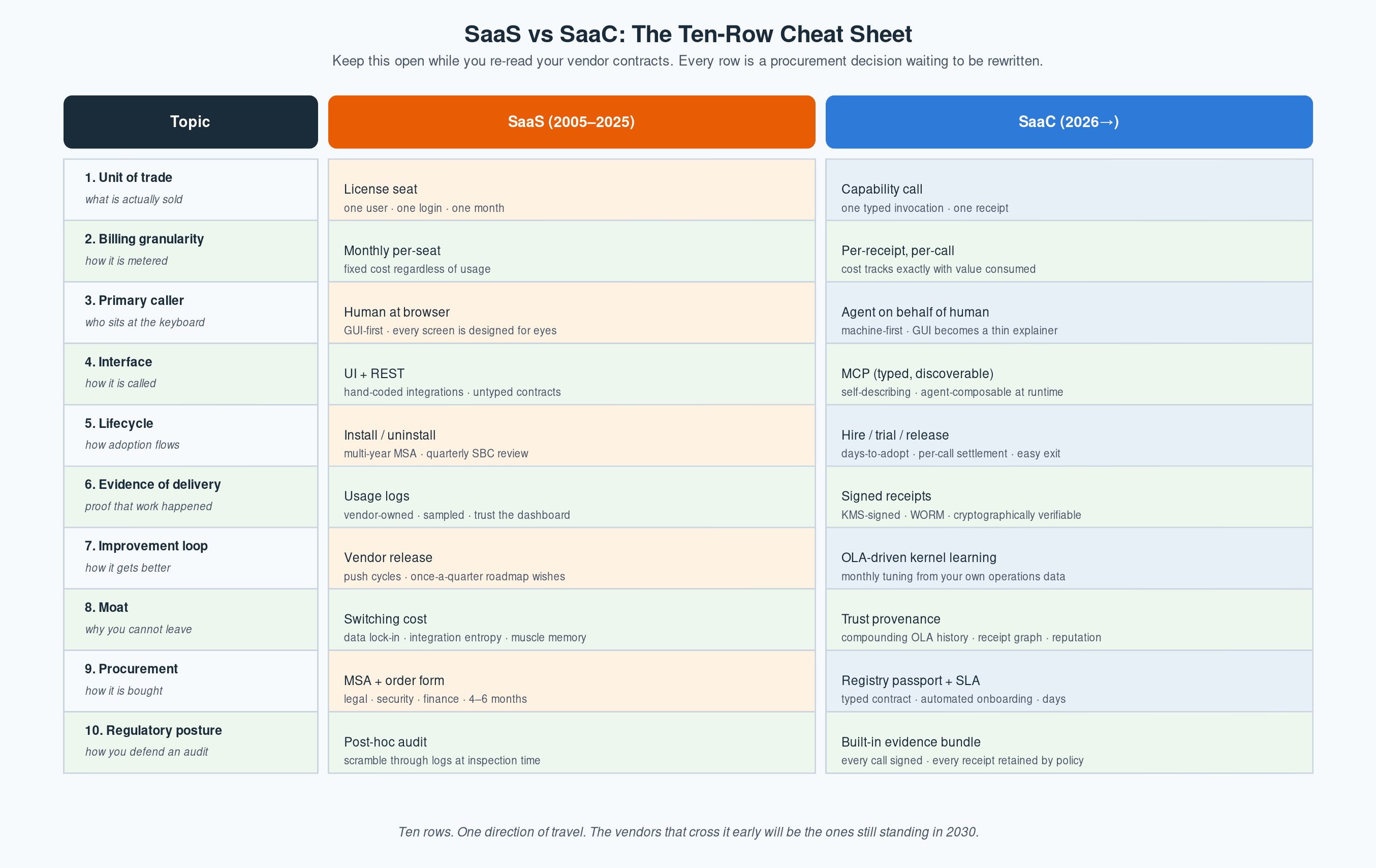
The diagram sets out the ten rows side by side. Read the left column and every row is a human caller; read the right column and every row is a reasoning caller. The difference is not a repricing: it is a rebinding of every assumption the product was shaped around.
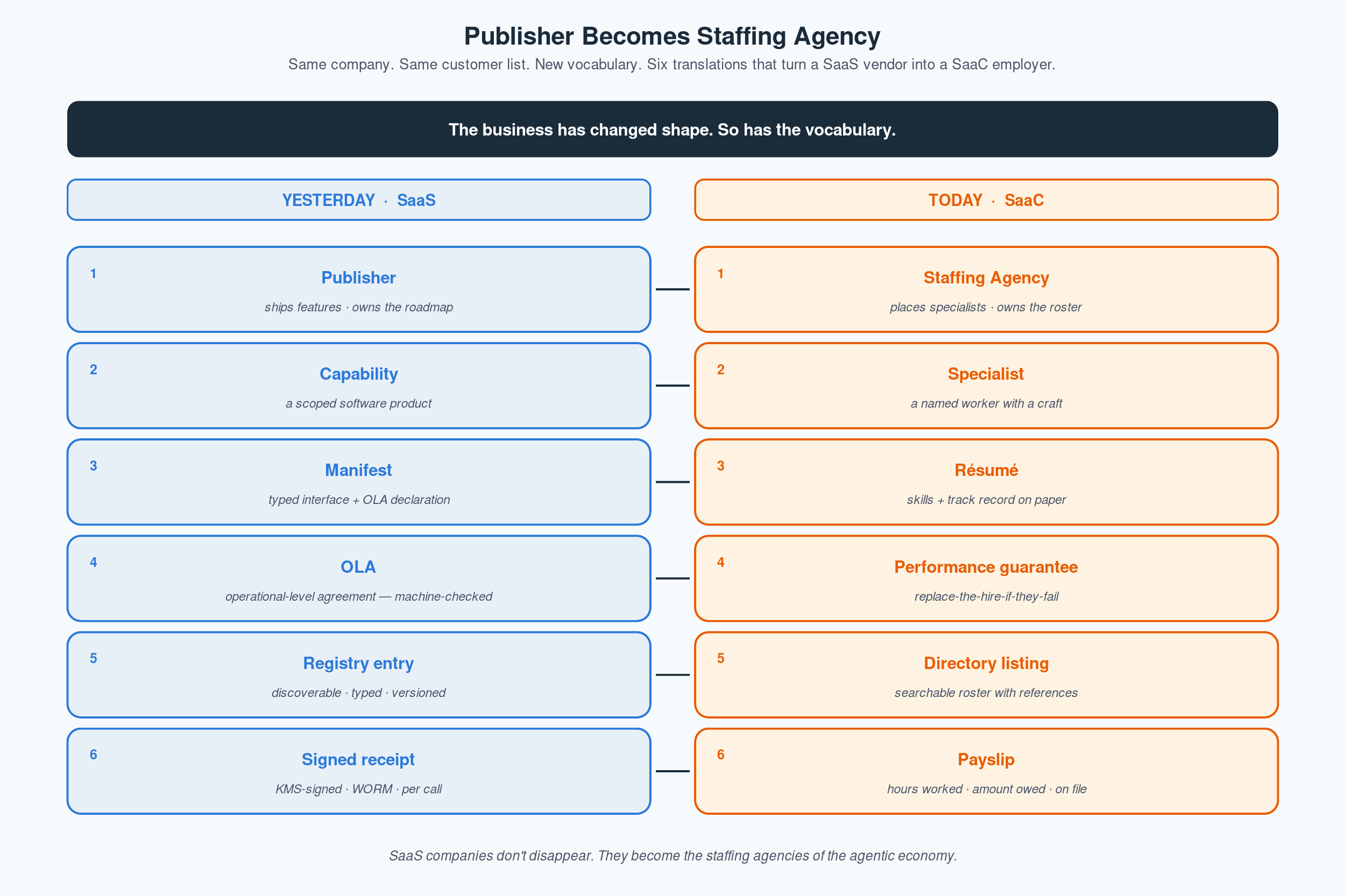
The diagram summarises the rebinding in a single glance: the publisher becomes the staffing agency, the capability becomes a specialist, the manifest becomes a résumé, the OLA (operational-level agreement, the service level a capability promises) becomes a performance commitment, the registry entry becomes a directory listing, and the signed receipt becomes a payslip. Every business term on the right has a crisp equivalent on the left; no term on the right has to be invented from scratch. That is the value of keeping the staffing metaphor load-bearing rather than decorative.
Objections and answers
The same objections to SaaC come up again and again. Here are the three most common.
Objection 1: "Our customers will not understand per-invocation pricing." True at first, and perhaps always for consumer products. In business-to-business (B2B) sales, customers already understand consumption billing (AWS, Snowflake, Twilio). SaaC pricing with sensible monthly-commit structures fits the same cognitive pattern. The transition requires a pricing page customers can simulate their bill on, which is easier, not harder, than traditional seat pricing.
Objection 2: "We lose the predictability of ARR." (ARR is annual recurring revenue.) Partially. SaaC pricing with commits plus overages is more variable than pure seat subscriptions, but the variance is narrower than it sounds: a monthly or annual commit sets a floor, and overages become predictable once there are a few months of usage history. The upside: net revenue retention can improve, because customers who get more value naturally consume more capabilities, and the revenue scales with the value.
Objection 3: "Per-invocation pricing invites abuse." Correct. Which is why every SaaC capability must have cost guardrails at the caller side (per-user daily budgets, per-capability monthly caps, spike-detection) and cost visibility in the product. Cloud data warehouses such as Snowflake have offered budgets and usage alerts for years; the patterns are well known.
Two further objections deserve answers because they come up in architecture review rather than sales negotiation. "Isn't this just serverless functions with a pricing page?" No, though a serverless function can be the kernel of a capability. The distinction is that a serverless function is invoked by name with arguments; a capability is discovered by manifest, negotiated for scope, bounded by guardrails, measured by outcome, and priced by invocation. An AWS Lambda function has none of those properties by default. It is the difference between a CPU instruction and a library: both execute code, but only one is composable at the level of organizational competence. "Isn't MCP just JSON-RPC with extra steps?" Also no. MCP uses JSON-RPC (a lightweight format for one program to call another) for its messages, as The Anatomy of a Capability, and the Protocol Shift will elaborate, but it adds a discovery model, a session model, a capability-negotiation handshake, and a standard way to describe tools. The relationship between MCP and JSON-RPC is like the relationship between HTTP, the web's request protocol, and TCP, the network connection underneath it: one rides on the other, but the layer on top is where the semantics live.
Synthesis
SaaS solved distribution, operations, and iteration when the caller was a human. When the caller is an agent, SaaS assumptions break at every layer: the UI, the API, the pricing, the documentation, the integration posture. SaaC is the delivery model that matches the new caller: capabilities, not seats; manifests, not PDFs; invocation-priced, not flat-subscribed. The Anatomy of a Capability sets out what a capability actually is.
One final framing before we move on. The SaaS-to-SaaC transition is often described as a protocol shift or a pricing shift, and it is those things, but the deeper shift is in what the vendor is actually selling. A SaaS vendor sells access to an application. A SaaC vendor sells a slice of organizational competence: a piece of reasoning, memory, and guarded action that can be composed into any caller's workflow. The product is the capability; the application, if it exists, is one of several surfaces. Teams that internalize this inversion build differently, price differently, staff differently, and compound differently. Teams that do not internalize it build SaaS with a usage meter bolted to the side and wonder why their customers' agents never compose their products.
The small print
Important notice. This article is part of my ongoing research into the Agentic Economy and reflects my thinking at the time of writing. It is shared in good faith, for information and discussion. It is not legal, regulatory, technical, financial or other professional advice, and it is not a verdict on how the EU AI Act or any other law applies to any organisation, system or situation. Laws, guidance, technology and my own research all move on, and others may reach different conclusions. The examples, designs, diagrams and technology choices show one possible approach. Before relying on, adapting or applying any part of it in your own situation, you must test and verify it, design it for your own architecture, and take independent expert advice, including from qualified lawyers and from your own IT, security and data protection specialists. Any decision to act on it, and its consequences, rest with you. To the fullest extent permitted by law, the author accepts no responsibility or liability for any loss, damage or consequence arising from any use of, or reliance on, this article, which is provided without any warranty of accuracy, completeness or fitness for a particular purpose. Reading it does not create a professional or advisory relationship with the author. The views expressed are the author’s own.